



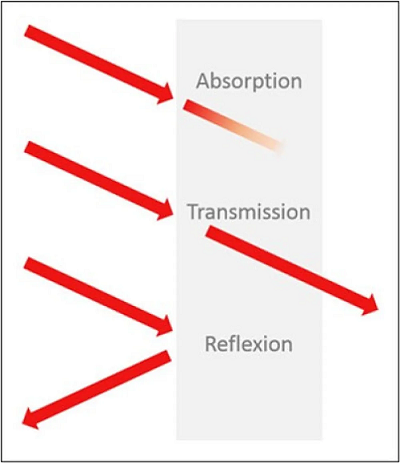
Absorption : 흡수
흑체의 경우 모든 입사 광을 흡수하며, 반사나 투과가 없습니다. 키르히호프의 열복사 법칙에 따르면 열적 평형에 있는 물체에서는 흡수율과 방사율이 서로 같습니다.
좁은 파장 구간에서 전자기 복사를 방출하고 흡수하는 물체의 경우에도 적절한 협대역 스펙트럼 필터를 사용하여 온도를 결정할
수 있습니다. 예를 들어, 얇은 플라스틱 필름은 주로 약 3.4 µm 부근의 C–H 신축 및 굽힘 진동 영역에서 적외선과 상호작용하며, CO2 또는 CO와 같은 화염 가스는 각각 약 4.2 µm 또는 4.6 µm 부근의 스펙트럼 영역에서 강하게 상호작용합니다. 일부 장비는 배경 복사에 집중하기 위해 가스의 흡수 및 방출을 의도적으로 억제할 수 있으므로, 적절한 측정 장비의 선택이 매우 중요합니다.
Electromagnetic radiation interacts with matter in three main ways: it can be reflected or diffusely scattered, transmitted through transparent objects, or absorbed. These interactions are described by the absorption (α), reflectivity (ρ), and transmissivity (τ) of the material, which are related by the equation: 1 = α + ρ + τ. The absorption of radiation represents the portion of energy converted into other forms, such as heat or chemical energy, within the material. It is a unitless ratio variable, ranging from 0 (no absorption) to 1 (complete absorption). The absorption depends on the material’s wavelength-dependent extinction coefficient, the length of the beam path in the material, and the density or concentration of the absorbing material.
For black bodies, all incident light is absorbed, and there is no reflection or transmission. Kirchhoff’s law of thermal radiation states that for a body in thermal equilibrium, absorption equals emission.
In the case of objects that emit and absorb electromagnetic radiation in a narrow wavelength interval, their temperature can still be determined using a suitable narrow-band spectral filter. For example, thin plastic films mainly interact with infrared radiation in the C-H stretch and bending vibration range around 3.4 µm, while flame gases such as CO2 or CO interact strongly in the spectral range around 4.2 µm or 4.6 µm. Selecting appropriate measuring devices is crucial, as some may intentionally suppress the absorption and emission of gases to focus on background radiation.