



Non-Uniformity-Correction (NUC) : 비균일성 보정
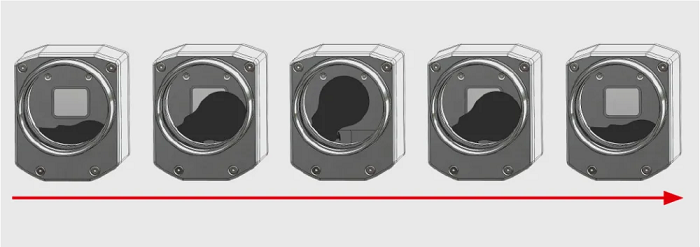
비균일성 보정(NUC)은 적외선 카메라의 운용에서 매우 중요한 과정입니다. 그 목적은 캡처된 열화상에서 본질적인 비균일성을 완화하는 것입니다. 특히 비냉각 마이크로볼로미터 센서를 사용하는 적외선 카메라는 픽셀 단위로 열복사에 대한 응답이 차이 나는 경우가 많습니다. 이러한 차이는 검출기 감도 차이, 전자적 잡음, 주변 환경 등에 의해 발생할 수 있습니다. 보정이 이루어지지 않으면 이러한 비균일성은 열화상의 품질과 정확도를 크게 저하시켜 잘못된 온도 판독과 열악한 화질을 초래할 수 있습니다.
비균일성 보정(NUC)은 카메라 광학계의 내부 적외선을 측정하고 이에 따라 영상을 조정함으로써 열영상의 정확도를 향상시킵니다. NUC를 수행하는 과정에서 대부분의 적외선 카메라는 플랫한 고방사율 표면을 가진 셔터 부품을 광로에 위치시켜 IR 광 경로를 일시적으로 차단합니다.
모든 열 검출기는 열복사에 노출되지 않았을 때조차도 신호를 생성하는데, 이를 "다크 값"이라고 합니다. 포컬 플레인 어레이 검출기의 경우 각 픽셀은 "다크 이미지" 또는 "다크 프레임"이라고도 하는 자체 다크 값을 갖습니다. 다크 값은 대상의 복사로부터 오는 신호에 대한 오프셋이며 실제 신호를 계산하기 위해 빼주어야 합니다. 검출기의 다크 프레임은 포컬 플레인 어레이의 온도에 따라 달라지며, 볼로미터의 경우 이 효과가 특히 큽니다. 볼로미터 칩 온도의 변화는 동일한 대상 온도 변화보다 출력에서 훨씬 큰 전압 차이를 유발합니다.
실제 다크 프레임을 결정하기 위해 이미저는 플래그(셔터 플래그라고도 함)를 사용합니다. 플래그는 전기 구동장치로 광로에 이동될 수 있는 작은 판이며, 검출기를 향한 면이 흑체처럼 동작하도록 흑색 처리되어 있습니다. 장치의 전체 크기를 줄이기 위해 플래그는 라멜라(lamellas)로 구성될 수 있습니다.
플래그가 검출기를 덮으면 모든 픽셀의 신호가 현재 유효한 다크 프레임으로 저장됩니다. 이 값들은 플래그가 다시 열린 후 이후의 모든 프레임에서 차감됩니다. 특히 예열 시간 동안 칩 온도가 드리프트하면 계산된 대상 온도에서 큰 드리프트가 발생하므로 주기적으로 플래그를 사이클하여 이를 보정해야 합니다.
Non-uniformity correction (NUC) is a crucial process in the operation of infrared cameras. Its purpose is to alleviate the inherent non-uniformities in the captured thermal images. Infrared cameras, especially those using uncooled microbolometer sensors, often suffer from variations in response to thermal radiation at a pixel level. These variations can be caused by differences in detector sensitivity, electronic noise, and ambient environment. Without correction, these non-uniformities can significantly reduce the quality and accuracy of the thermal images, leading to incorrect temperature readings and poor image quality.
Non-uniformity correction (NUC) improves the accuracy of thermal images by measuring the internal infrared radiation from the camera’s optics and making adjustments to the image accordingly. In the process of performing a NUC, most infrared cameras temporarily block the IR optical path by positioning a shutter component with a flat, high-emissivity surface in place.
All thermal detectors generate a signal even when not exposed to thermal radiation, which is referred to as a “dark value”. For focal plane array detectors, each pixel has its dark value, also known as a “dark image” or “dark frame”. The dark value is an offset to the signal caused by the radiation from the target and must be subtracted to calculate the real signal. The dark frame of the detector depends on the temperature of the focal plane array, and for bolometers, this effect is particularly significant. A change in the bolometer chip temperature causes a much larger voltage difference at the output than the same change in the target temperature.
To determine the actual dark frame, an imager uses the flag, also called a “shutter flag”. The flag is a small plate that can be moved by an electrical drive into the optical path and is blackened on the side facing the detector to ensure it behaves like a black body. To reduce the overall size of the device, a flag could be made from lamellas.
When the flag covers the detector, the signals of all pixels are stored as the current valid dark frame. These values are then subtracted from any succeeding frame after the flag is reopened. Especially during the warm-up time, the chip temperature drifts, causing a significant drift in the calculated target temperature, which must be corrected by periodically cycling the flag.