



Midwave Infrared (MWIR) : 중파장 적외선 (MWIR)
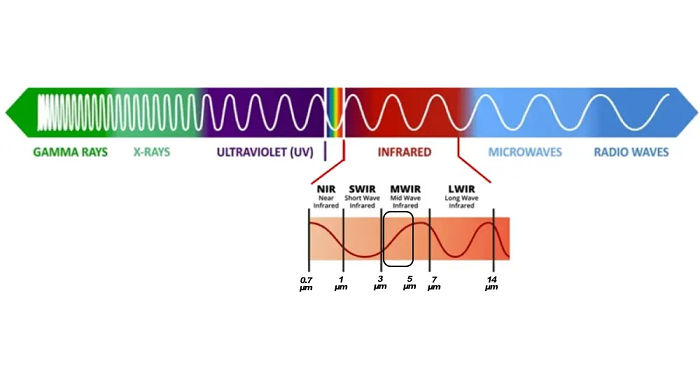
적외선 카메라는 카메라 설계(휴대용, 고정 설치, 아이폰), 성능 속성(고속, 고감도, 고해상도) 또는 적용 분야(비파괴 검사, 고온 금속 영상 및 측정, 가스 영상, 현미경 영상) 등 여러 방식으로 분류되거나 표기됩니다.
과학적 응용에 자주 사용되는 카메라를 분류하는 또 다른 방법은 적외선 영상을 생성하는 데 사용되는 적외선 방출을 카메라가 수신하는 스펙트럼 영역을 식별하는 것입니다. 중파장 적외선(MWIR) 카메라는 적외선 스펙트럼의 중간 영역의 복사에 반응하는 검출기를 특징으로 하며 일반적으로 3~5 µm 범위의 스펙트럼에서 제공됩니다.
중파장 적외선 카메라는 1980년대 초 비냉각 장파장 마이크로볼로미터 적외선 검출기 기술이 출시되기 전, 예측 유지보수 및 기타 신생 적외선 응용을 지원하기 위해 대량으로 판매되었습니다. 이러한 카메라는 열전적으로 냉각되는 InSb(안티몬화 인듐) 검출기를 사용했습니다. 저렴한 2차원 검출기 배열이 대량 생산으로 이용 가능해지기 전에는 작은 선형 배열로부터 열영상을 생성하기 위해 프리즘 스캐닝 시스템을 일반적으로 통합했습니다.
오늘날의 고체 상태 장파장 비냉각 카메라와 비교하면 실용적이지 않았지만, 이 초기 적외선 카메라들은 액체 질소가 필요한 카메라보다 배치가 훨씬 쉬웠고 예측 유지보수 프로그램을 위해 전력 회사와 제조 시설에서 널리 채택되었습니다. 이들 중파장 카메라의 고해상도 변형은 연구개발 응용을 지원했습니다.
오늘날 중파장 적외선 카메라는 주로 연구 목적이나 중간 파장대의 스펙트럼 응답이 필요한 특수 응용 분야를 위해 판매됩니다.
중파장 적외선 카메라는 고해상도, 높은 열 감도 또는 고속 데이터 수집을 요구할 수 있는 까다로운 연구 응용에서 인기가 있습니다. 새로운 중파장 슈퍼격자 적외선 검출기가 장착된 카메라도 지금은 출시되어 있지만, 인디움 안티모나이드(Indium Antimonide, InSb) 중파장 검출기는 더 높은 양자 효율을 제공하므로 고감도나 고속이 중요한 경우 더 선호되는 선택입니다.
이러한 저온 냉각식 중파장 적외선 카메라는 매우 비싸지만, 주변 온도(또는 그 이상) 대상에서 1000 Hz에서 3000 Hz(풀 프레임)의 데이터 수집이 필요할 때 실현 가능한 해결책입니다. 이들 카메라가 활용되는 응용 분야로는 이동 물체의 열 신호에 대한 방위 관련 연구, 고속 철도 부품 측정, 인장 시험 및 탄약 시험 등이 있습니다.
모든 중파장 전용 응용이 고가의 고속 고감도 냉각식 검출기 기반 카메라를 필요로 하는 것은 아닙니다.
공정로에서 내화물 온도나 튜브 온도를 측정하는 것은 연소 산물이 적외선 신호를 약화시키기 때문에 특히 장파장 카메라로 열 영상과 온도 정보를 수집할 때 도전적인 응용입니다. 이산화탄소, 수증기 및 기타 가스는 LWIR 카메라의 스펙트럼 응답과 동일한 파장에서 신호를 흡수하여 영상 품질과 측정 정확도를 저하시킵니다. 3.9 µm로 튜닝된 스펙트럴 필터를 갖춘 특수 설계 중파장 카메라는 이러한 가스와 증기에 의한 감쇠가 최소화되는 스펙트럼 영역에서 방사 온도를 포착합니다.
이러한 특수 설계 중파장 카메라는 주검출기 응답이 장파장 스펙트럼 영역에 있는 마이크로볼로미터 검출기를 사용합니다. 그러나 로 내부의 전형적인 대상 온도가 700°C를 초과하기 때문에 이들 검출기의 장파장 응답은 필터링되어 검출기의 중파장 응답 영역만 활성화될 수 있습니다. 비록 이들 검출기에서 중파장 응답은 장파장 영역의 응답보다 훨씬 약하지만, 내부 공정 튜브나 내화벽에서 나오는 방사 강도는 선명한 열 영상과 정확한 온도 측정을 생성하기에 충분합니다.
중파장 검출기를 탑재한 적외선 카메라는 당분간 적외선 카메라 시장의 소규모 부분으로 남을 가능성이 높지만, 연구개발 및 중파장 검출기 기반 카메라가 가장 적합한 기타 특수 응용 분야에서는 중요한 역할을 수행할 것입니다.
Infrared cameras are categorized or labeled in many ways including camera design (handheld, fixed install, iphone), performance attribute (high speed, high sensitivity, high resolution) or application (non-destructive testing, high temperature metal imaging and measurement, gas imaging, microscopic imaging).
Another approach to categorize cameras commonly used for scientific applications is to identify the spectral region from which the camera receives the infrared emissions used to present its infrared image. Midwave infrared (MWIR) cameras feature detectors responsive to infrared radiation in the middle of the infrared spectrum and are typically available in the spectral range between 3 and 5 µm.
Mid-wave infrared cameras were sold in large quantities before the release of uncooled long wave microbolometer infrared detector technology to support predictive maintenance and other emerging infrared applications in the early 80’s. These cameras made use of InSb (indium antimonide) detectors that were cooled thermoelectrically. They commonly incorporated prism scanning systems that were necessary to produce thermal images from small linear arrays before affordable two-dimensional detector arrays became available in production quantities.
Although impractical when compared to today’s solid state long wave uncooled cameras, these early infrared cameras were much easier to deploy than cameras requiring liquid nitrogen and were largely adopted by utilities and manufacturing facilities for predictive maintenance programs. Higher resolution variants of these midwave cameras supported research and development applications.
Today, midwave infrared cameras are sold mostly for research purposes or for special applications where spectral response in the mid wavelength is required.
Midwave infrared cameras are popular for demanding research applications that may require high resolution, high thermal sensitivity or high-speed data acquisition. Although new midwave superlattice infrared detector-equipped infrared cameras are now available, the higher quantum efficiency of Indium Antimonide (InSb) midwave detectors make them a more popular choice when high sensitivity or high speed is important.
These cryogenically cooled midwave infrared cameras are very expensive but they are a viable solution when data collection at 1000 hz. to 3000 hz. (full frame) is required on ambient (and above) temperature targets. Applications served by these cameras include defense related research on thermal signatures of moving targets, high-speed railway component measurement, tensile testing and munitions testing.
Not all midwave specific applications require expensive high speed hypersensitive cooled detector based cameras.
Measuring the refractory temperatures or the tube temperatures in a process furnace is a challenging application because the products of combustion attenuate the infrared signal particularly when long wave cameras are used to collect thermal image and temperature information. Carbon dioxide, water vapor and other gases absorb the signal in the same wavelength of the LWIR camera spectral response reducing image quality and measurement accuracy. Special design midwave cameras with spectral filters tuned to 3.9 µm capture radiating temperatures in a spectral region where attenuation from these gases and vapors is minimal.
These special design midwave cameras make use of microbolometer detectors where the primary detector response is in the long wavelength spectral region. However, because the typical targets on the inside of a furnace are in excess of 700° Celsius, the long wave response of these detectors can be filtered out leaving only the midwave response region of the detector active. Even though the midwave response on these detectors is much less than the response in the longer wavelength region, the intensity of the radiation from interior process tubes or refractory walls is more than enough to produce clear thermal images and accurate temperature measurements.
Infrared cameras with midwave detectors will likely remain a small portion of the infrared camera market for the foreseeable future, but will fill an important role for research and development and other special applications served best by midwave detector based cameras.