



Measurement Field of View (MFOV) : 측정 시야각 (MFOV)
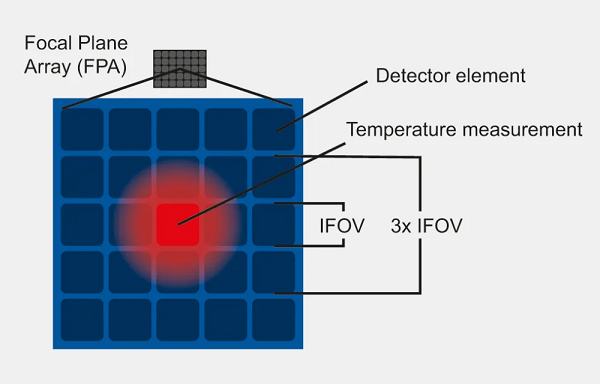
측정 시야각(MFOV)은 정확한 온도 판독을 얻기 위해 필요한 가장 작은 대상 크기를 정의합니다. 일반적으로 대상 에너지의 90%를 얻을 수 있는 3×3 또는 4×4 픽셀 크기의 물체로 정의됩니다. 열화상에서의 MFOV는 광학적 온도계(pyrometer) 장치의 측정 지점(measuring spot)에 해당합니다. 픽셀 배열로 인해 MFOV는 일정한 개수의 개별 픽셀을 포함하므로 순간 시야각(instantaneous FOV)과 연관됩니다.
이를 고려하여 다음 관계를 정의할 수 있습니다
MFOV=m⋅IFOV
값 m은 측정 지점 크기에 도달하는 데 필요한 픽셀 수 m을 나타내고, 순간 시야각(Instantaneous Field of View, IFOV)은 센서 배열의 한 픽에 해당하며 영상 시스템이 감지할 수 있는 가장 작은 대상 크기를 정의합니다.
보다 자세한 이해를 위해 순간 시야각을 사용할 수 있습니다
IFOV[mrad]≈pixelsizef
그리고 MFOV를 영상 카메라의 초점 거리 f와 같은 광학 매개변수에 연결합니다:
MFOV[mrad]≈m⋅pixelsizef
이 경우 IFOV와 MFOV는 일종의 공간 분해능이며 작은 물체의 온도 측정을 명확히 하기 위해 고려되어야 합니다. 픽셀 크기와 초점 거리는 잘 정의되어 있지만, 픽셀 수 m은 임의로 보일 수 있습니다. 정밀한 온도 측정을 위해서는 둘러싸인 에너지의 90% 값이 도달할 만큼 충분히 커야 합니다. 에어리 원판(Airy disk)의 두 번째 영점(zero)이 전체 에너지의 91%를 포함하기 때문에, 온도 측정을 위한 에어리 직경을 다음과 같이 정의할 수 있습니다:
d0,91=4.5⋅λ⋅N
여기서 λ는 적용되는 파장이고 N은 광학계의 F수(F-number)입니다. 이 에어리 원판 직경은 에너지가 84%만 포함되는 표준 정의(에어리 분포의 첫 번째 영점)와 비교하여 거의 두 배입니다.
F-넘버가 낮을수록 센서에 얻을 수 있는 스폿의 직경은 작아집니다. 실제 응용에서는 열화상 카메라의 실제 성능이 중요합니다. 에어리(Airy) 직경이 이상적인 경우의 한계를 정하는 반면, 광학계의 실제 성능은 적외선 카메라의 광학 해상도를 추가로 제한할 수 있습니다.
카메라 크기와 센서 크기가 작아짐에 따라 픽셀 크기는 점차 줄어듭니다. 회절 한계로 인해 발생하는 일정한 스폿 직경이 유지되는 경우, 픽셀 크기가 줄어들수록 IFOV가 달성하는 성능은 떨어집니다. 스폿 직경(Airy 디스크)은 동일하게 유지되는 반면 픽셀은 계속 작아집니다. 이러한 경우 더 작은 픽셀 크기는 보다 엄격한 화질을 요구하며 향상된 광학 성능을 필요로 합니다.
사용자는 특정 거리에서의 관측에 관심을 가지며 FOV를 mm 또는 m 단위로 알고자 하고, 객체의 크기가 최소한 MFOV 이상인지 확인하기를 원할 때가 많습니다. FOV 계산기는 사용된 카메라/광학 장비를 입력할 수 있게 하며 HFOV, VFOV, IFOV 및 MFOV와 같은 모든 필요한 FOV 데이터를 표시합니다.
열화상 카메라에서 FOV의 선택은 작은 세부를 구분하는 능력을 의미하는 카메라의 광학 해상도와 밀접하게 연관됩니다. 광학 해상도(또는 공간 해상도)가 높은 카메라는 더 미세한 세부를 분해할 수 있어 작은 물체나 먼 물체를 검사할 때 중요합니다. 이러한 광학 해상도는 일반적으로 시야각이 좁은 카메라에서 더 높습니다. 따라서 FOV와 광학 해상도 사이의 절충은 생성되는 열영상의 품질과 사용성 모두에 영향을 미치는 열화상 분야에서 중요한 고려사항입니다.
The measurement field of view (MFOV) defines the smallest target size required to obtain accurate temperature readings. It is usually defined for an object size of 3×3 or 4×4 pixels, where 90% of the target’s energy is obtained. The MFOV for thermal imaging is the equivalent of the measuring spot for pyrometer devices. Due to the pixel arrangement, it contains a discrete number of individual pixels so that it is linked to the instantaneous FOV.
Taking this into account we can define the relation
MFOV=m⋅IFOV
The value m represents the number of pixels m needed to reach the measurement spots size and the Instantaneous Field of View (IFOV) corresponds to one pixel of the sensor array and defines the smallest target size that can be detected by the imaging system.
For a more detailed understanding we can use the instantaneous FOV
IFOV[mrad]≈pixelsizef
and the link the MFOV to the optics parameter like focal length f of the imaging camera:
MFOV[mrad]≈m⋅pixelsizef
In that case, the IFOV and MFOV are a type of spatial resolution and must be taken into account to clarify the temperature measurement of small objects. While pixel size and focal length are well defined, the number of pixels m seems to be arbitrary. For a precise temperature measurement, it is just as large as the 90% of encircled energy value is reached. Because the 2nd zero of the Airy disk is containing 91% of the energy, we can define the airy diameter for temperature measurement as follows:
d0,91=4.5⋅λ⋅N
were λ is the applied wavelength and N is the F-number of the optics. This Airy disk diameter is nearly double compared to the standard definition (first zero of the Airy distribution) where only 84 % of the energy is contained.
The lower the F-number, the smaller the diameter of the spot that we can achieve on our sensor. In practical applications, the actual performance of the thermal imaging camera is important. While the Airy diameter sets the limit for the best case, the real performance of the optics can also limit the optical resolution of the infrared camera.
As the camera size and sensor size becomes more compact, the pixel size is gradually reduced. With a constant spot diameter, which is caused by the diffraction limit, the performance achieved for the IFOV decreases as the pixel size decreases. While the spot diameter (Airy disk) remains the same, the pixel shrinks more and more. In this case, smaller pixel sizes lead to a more demanding image quality and require improved optical performance.
Often the user is interested in a special distance and wants to know the FOV in mm or m and wants to make sure the object size is at least the MFOV. The FOV calculator enables to enter the used camera/optics and is showing all necessary FOV data like HFOV, VFOV, IFOV and MFOV.
The selection of the FOV in thermography cameras is closely linked to the camera’s optical resolution, which refers to its ability to distinguish small details. A camera with a high optical resolution (or spatial resolution) can resolve finer details, which is critical when examining small or distant objects. This optical resolution is typically higher in cameras with narrower fields of view. Therefore, the trade-off between FOV and optical resolution is a key consideration in thermography, affecting both the quality and usability of the thermal imaging results which are produced.