



Long-wavelength infrared (LWIR) : 장파장 적외선 (LWIR)
적외선 카메라는 카메라 설계(휴대용, 고정 설치, 아이폰 등), 성능 특성(고속, 고감도, 고해상도) 또는 응용 분야(비파괴 검사, 고온 금속 영상 및 측정, 가스 영상, 현미경 영상) 등에 따라 여러 방식으로 분류되거나 표기됩니다.
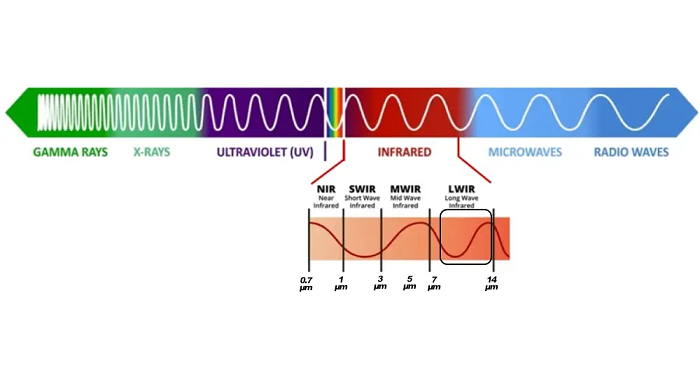
과학적 응용에 흔히 사용되는 카메라를 분류하는 또 다른 방법은 적외선 영상을 생성하는 데 사용되는 적외선 방출을 카메라가 수신하는 스펙트럼 영역을 기준으로 식별하는 것입니다. LWIR 카메라는 8~14 µm 범위의 방출에 반응하는 적외선 검출기를 장착하고 있습니다.
LWIR 카메라는 단연 가장 일반적이며 보안(야간 시야), 자동차 및 해상 항법, 공정 제어, 예측 유지보수, 건물 진단 및 연구 등 다양한 응용 분야에서 사용됩니다. 특히 마이크로볼로미터 검출기 설계와 같은 적외선 검출기 기술의 발전은 LWIR 카메라를 저렴하게 만들어 널리 보급된 이유가 됩니다.
마이크로볼로미터 검출기 설계는 또한 90년대 후반 마이크로볼로미터 검출기가 상업적으로 널리 채택되기 전까지 일반적이었던 장파 포토볼타익 검출기에 요구되던 극저온 냉각의 필요성을 없앴습니다. 보안, 건물 진단, 수색 및 구조, 소방 등 가격 민감도가 높은 시장은 마이크로볼로미터 검출기가 더 비싼 냉각식 적외선 검출기 기술을 대체하면서 발전했습니다.
또한 고체 상태의 마이크로볼로미터 설계는 비용이 많이 들고, 하루 24시간, 주 7일 온도 데이터 수집이 필요한 공정 모니터링 응용에는 비실용적이었던 기계식 검출기 냉각 메커니즘의 필요성도 제거했습니다.
플랑크 법칙(Plank’s law)은 표면에서 방출되는 복사 에너지의 최댓값이 파장에 따라 어떻게 달라지는지를 정의하며, 주변 온도 범위에 있는 대상체는 적외선을 가장 효율적으로 8µm에서 14µm 사이의 장파장 영역에서 방출합니다. 가격이 저렴하다는 점 외에도 주변 온도 조건에서 사용하기에 적합하다는 점이 널리 채택된 이유입니다.
온도 측정은 공정 제어, 예측 유지보수, 건물 진단 및 연구 응용 분야에서 사용되는 카메라의 중요한 기능입니다. NIR(근적외선) 카메라는 가시광선 스펙트럼에 가까운 짧은 파장의 검출기를 사용하며 광원 방출의 영향을 받을 수 있습니다. 이러한 이유로 광 스펙트럼에서 가장 멀리 떨어진 검출기 반응을 가진 LWIR 장비가 온도 측정 응용에 선호됩니다. 이 규칙의 예외로는 방사율이 낮은 표면에서의 고온 측정이 있는데, 이러한 경우 NIR 또는 SWIR 적외선 카메라로 더 효율적으로 측정할 수 있습니다.
마이크로볼로미터 검출기 기술을 사용하는 대부분의 LWIR 카메라는 서브프레임 모드에서 30Hz에서 125Hz 사이의 프레임 속도로 적외선 영상을 생성할 수 있어 대부분의 응용 분야를 충족합니다. 그러나 고속 생산 공정에서의 측정, 폭발이나 전기 펄스와 같은 동적 연구 응용에서는 더 빠른 프레임 속도가 필요할 수 있으며, 이는 일반적으로 더 짧은 파장에서만 구할 수 있는 광전(Photovoltaic) 또는 CMOS 검출기로 가능해집니다.
일부 고성능 장파 카메라는 냉각된 수은 카드뮴 텔루라이드(Mercury Cadmium Telluride, MCT) 또는 양자우물(Quantum Well) 센서를 사용하여 고해상도 및 매우 높은 열 민감도의 열 영상을 제공합니다. 이들 검출 재료는 비냉각 센서보다 반응 속도가 빠르며 풀프레임 모드에서 최대 1000Hz의 프레임 속도를 지원하고, 이미지의 픽셀 수를 줄여 기록할 경우 최대 40배 더 빠른 속도를 지원합니다. 이러한 카메라는 가격이 비싸고 소량 판매되지만, 비냉각 장파 검출기 기술로는 얻을 수 없는 고속 데이터 캡처가 필요한 특정 응용 분야를 다룰 수 있습니다.
마지막으로, 장파 냉각 양자우물(Quantum Well) 검출기는 카메라의 스펙트럼 응답을 육불화황(sulfur hexafluoride)이나 암모니아 가스와 같은 가스의 흡수 대역(10.6 µm)에 맞추어 좁히는 설계로 제공됩니다. 검출기가 매우 민감하기 때문에, 스펙트럼 범위를 좁혀 적외선 에너지가 크게 줄어들더라도 작은 누출에서 발생한 가스 구름을 명확하게 시각화할 수 있습니다.
LWIR 카메라는 당분간 전 세계적으로 판매되는 적외선 카메라의 주류 유형으로 남을 것입니다. 특수 기능, 새로운 설계 및 액세서리를 갖춘 LWIR 카메라의 새로운 변형이 등장하여 증가하는 열화상 응용 목록에 적합한 틈새 응용 분야를 해결할 것입니다.
Infrared cameras are categorized or labeled in many ways which may be driven by camera design (handheld, fixed install, iphone), performance attribute (high speed, high sensitivity, high resolution) or application (non-destructive testing, high temperature metal imaging and measurement, gas imaging, microscopic imaging).
Another approach to categorize cameras commonly used for scientific applications is to identify the spectral region from which the camera receives the infrared emissions used to present its infrared image. LWIR infrared cameras are equipped with infrared detectors responsive to emissions between 8 and 14 µm microns.
LWIR cameras are by far the most common and are used in a wide variety of applications including security (night vision), auto & marine navigation, process control, predictive maintenance, building diagnostics and research. Advances in infrared detector technology, particularly in microbolometer detector design have made LWIR cameras affordable, which accounts for their broad adoption.
Microbolometer detector design also eliminates the need for cryogenic cooling which was a requirement for long wave photovoltaic detectors common before the broad commercial adoption of microbolometer detectors in the late 90’s. Price sensitive markets such as security, building diagnostics, search and rescue and firefighting developed as microbolometer detectors replaced more expensive cooled IR detector technology.
The solid state microbolometer design also eliminated the need for a mechanical detector cooling mechanism which was not only expensive but impractical for process monitoring applications where temperature data collection was required 24 hours per day, seven days a week.
Plank’s law defines the peak efficiency of radiant energy emitted from a surface as a function of wavelength and targets in the ambient temperature range emit infrared radiation most efficiently in the long wavelength region between 8 and 14 µm microns. In addition to affordability, suitability for use in ambient temperature ranges also explains their broad adoption.
Temperature measurement is an important feature for cameras used in process control, predictive maintenance building diagnostics and research applications. NIR or Near infrared cameras use detectors in the shorter wavelengths close to (near) the visible light spectrum and can be influenced by light emissions. For this reason, LWIR cameras with detector response most distant from the light spectrum are preferred for temperature measurement applications. Exceptions to this rule include high temperature measurements on lower emissivity surfaces which are more effectively measured with NIR or SWIR infrared cameras.
Most LWIR cameras using microbolometer detector technology are capable of producing infrared images at frame rates between 30hz and 125 hz (with sub-frame mode) which addresses most applications. However, measurements on high-speed production processes, dynamic research applications such as measurement on explosions or electrical pulses may require faster frame rates which are possible with photovoltaic or CMOS detectors commonly available only in shorter wavelengths.
Some special high performance long wave cameras use cooled Mercury Cadmium Teluride or Quantum well sensors to deliver thermal images with high resolution and very high thermal sensitivity. Both these detector materials have faster response times than the uncooled sensors and will support frame rates up to 1000 hz. in full frame mode and up to 40 times faster when a reduced pixel count region of the image is recorded. Although these cameras are expensive and sold in small quantities, they can address certain applications that require fast data capture unable to be acquired with uncooled long wave detector technology.
Finally, a long wave cooled Quantum Well detector is available in a design that narrows the spectral response of the camera to a wavelength that is coincident with absorption band of gases (10.6 µm) such as sulfur hexafluoride or ammonia gas. Because the detector is highly sensitive, it can produce a clearly visible gas cloud from a small leak even when the narrowed spectral range dramatically reduces the infrared energy exposed to the detector.
LWIR cameras will continue to remain the dominant type of infrared camera sold worldwide for the foreseeable future. New variants of LWIR cameras will emerge that address niche applications with special features, new designs and accessories that make them a perfect fit for the growing list of thermal imaging applications.