



Instantaneous Field of View (IFOV) : 순간 시야각(IFOV)
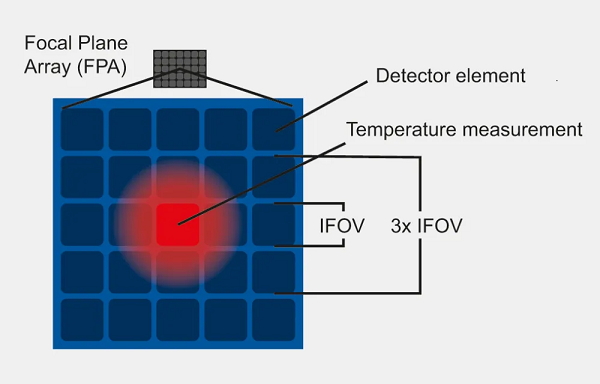
순간 시야각(Instantaneous Field of View, IFOV)은 영상 시스템이 감지할 수 있는 가장 작은 목표 크기로, 센서 어레이의 한 픽셀을 나타내며 판별 가능한 가장 작은 물체 크기를 결정합니다. 이는 일반적으로 수평 시야(HFOV)와 연관되며 IFOV=HFOV/n(여기서 n은 수평 시야의 픽셀 수) 공식을 사용하여 계산할 수 있습니다. IFOV은 평균값이며, 특히 광각 광학의 경우 시야의 중심에서 가장자리로 갈수록 달라질 수 있습니다.
공간 해상도의 중요한 요소이며 작은 물체의 온도 측정에 영향을 미칩니다. 작은 FOV는 더 작은 IFOV와 더 높은 광학 해상도에 해당합니다. 이는 IFOV [mrad] ≈ 픽셀 크기/초점거리(f)라는 식으로 카메라의 광학 파라미터와 연결할 수 있으며, 픽셀 크기가 작고 초점거리가 길수록 IFOV가 개선됩니다.
센서 특성(픽셀 피치)과 광학 파라미터(초점 거리)는 모두 시야(FOV)에 영향을 미칩니다. 이론적 계산만으로는 충분하지 않으며, IFOV 내의 물체를 분해할 수 있는지를 보장하기 위해 실험적인 검증이 필요합니다. 센서 크기가 점점 더 소형화됨에 따라 픽셀 크기가 줄어들어 보다 까다로운 화질 요구가 발생하며, 이는 향상된 광학 성능을 필요로 합니다.
정확한 온도 측정을 위해서는 회절 한계 때문에 목표물의 크기가 IFOV보다 커야 합니다. 일반적으로 최소 시야(MFOV)를 정의하는 에너지의 90%를 얻기 위해서는 3×3 또는 4×4 픽셀 크기의 목표물이 필요합니다. 더 작은 픽 크기는 IFOV과 유사한 문제를 일으키며, 센서 크기를 일정하게 유지하면서 어레이의 픽 수를 늘리는 것이 권장되는 해결책입니다.
사용자들은 종종 특정 거리에서의 FOV를 mm 또는 m 단위로 알고자 하며, 대상 물체 크기가 적어도 MFOV 이상인지 확인해야 합니다. FOV 계산기는 HFOV, VFOV, IFOV, MFOV 등 필요한 다른 FOV 데이터를 제공할 수 있습니다.
열화상 카메라에서 FOV의 선택은 작은 세부를 구분하는 능력을 결정하는 카메라의 광학 해상도와 밀접한 관련이 있습니다. 광학 해상도가 높은 카메라는 특히 좁은 시야에서 더 미세한 세부를 분해할 수 있습니다. 따라서 열화상에서는 FOV와 광학 해상도의 균형이 매우 중요하며, 이는 열영상 결과의 품질과 활용성에 영향을 미칩니다.
The Instantaneous Field of View (IFOV) is the smallest target size detectable by an imaging system and represents one pixel of the sensor array, determining the smallest resolvable object size. It is usually associated with the horizontal FOV and can be calculated using the formula IFOV=HFOV/n, where n is the number of pixels in the horizontal FOV. The IFOV is an average value that can vary from the center to the edge of the FOV, especially for wide-angle optics.
It is a critical factor for spatial resolution and influences the temperature measurement of small objects. A smaller FOV corresponds to a smaller IFOV and higher optical resolution. It can be linked to the camera’s optics parameters by the equation IFOV [mrad] ≈ pixel size/f, where a smaller pixel size and larger focal length improve the IFOV.
Both sensor properties (pixel pitch) and optical parameters (focal length) affect the FOV. Theoretical calculations alone are insufficient; practical tests are necessary to ensure resolvability of objects within the IFOV. As sensor sizes become more compact, pixel sizes reduce, leading to more demanding image quality and necessitating improved optical performance.
For accurate temperature measurements, the target size must be larger than the IFOV due to the diffraction limit. Typically, a target size of 3×3 or 4×4 pixels is required to achieve 90% of the energy that defines the Minimum Field of View (MFOV). Smaller pixel sizes present challenges similar to those for the IFOV, and increasing the number of pixels in the array while keeping the sensor size constant is the recommended solution.
Users often seek the FOV in mm or m for specific distances and need to ensure that the object size is at least the MFOV. A FOV calculator can provide this and other necessary FOV data, such as HFOV, VFOV, IFOV, and MFOV.
The selection of the FOV in thermography cameras is closely related to the camera’s optical resolution, which determines its ability to distinguish small details. Cameras with higher optical resolution can resolve finer details, especially in narrower fields of view. Thus, balancing FOV and optical resolution is crucial in thermography, impacting the quality and usability of the thermal imaging results.