



Infrared Scanner System: 적외선 스캐너 시스템
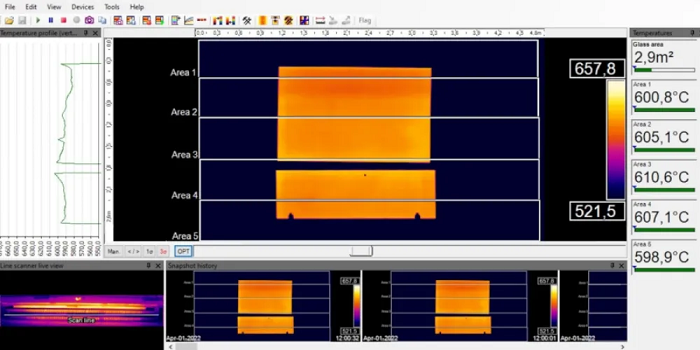
적외선 스캐너 시스템은 넓은 영역에 대해 비접촉 온도 측정을 수행하는 특수 장치입니다. 이 시스템은 단일 선을 따라 온도 데이터를 캡처한 다음 회전 거울이나 기타 기계적 스캐닝 메커니즘을 사용하여 이 선을 관심 영역에 걸쳐 스윕함으로써 한 줄씩 2차원 온도 지도를 생성합니다. 적외선 스캐너는 고속 스캐닝 능력으로 알려져 있어 빠르게 움직이는 공정이나 물체를 모니터링하는 데 적합합니다.
제조 분야에서 적외선 스캐너는 철강 및 유리 생산, 종이 및 플라스틱 제조와 같은 공정의 온도 모니터링 및 제어에 사용됩니다. 또한 컨베이어 벨트 위의 재료 검사, 가마와 용광로의 온도 분포 모니터링, 자동차 부품 생산 중 검사 등에도 활용됩니다.
전통적인 적외선 스캐너 시스템은 다양한 산업 응용에서 유용하지만 몇 가지 단점이 있습니다. 중요한 단점 중 하나는 스캐닝을 위한 기계적 구성 요소에 의존한다는 점입니다. 회전 거울이나 기타 기계 부품은 시간이 지남에 따라 마모되어 유지보수 문제와 잠재적 가동 중단을 초래할 수 있습니다. 이러한 기계적 복잡성은 장치의 전체 비용과 크기를 증가시켜 다른 적외선 영상 기술에 비해 덜 컴팩트하고 더 비싸게 만듭니다. 또한 전통적 스캐너는 일반적으로 현대적 적외선 카메라에 비해 시야각이 좁아 더 정확한 위치 선정이 필요하고 동일한 영역을 커버하기 위해 더 복잡한 설치가 요구될 수 있습니다. 아울러 스캔 선을 따라 해상도가 스캔 방향에 비해 일반적으로 높아 결과 열영상에서 세부 표현이 불균일해질 수 있습니다.
적외선 카메라 기반의 스캐너는 더 적은 문제와 낮은 비용으로 동일한 기능을 제공하는 정교한 대안입니다. 소프트웨어 알고리즘이 포컬 플레인 어레이(focal plane array)에 대각선 라인을 매핑하고 각 프레임에서 온도 데이터를 샘플링하여 새로운 이미지로 매핑합니다. 이 소프트웨어는 라인이 직선일 필요가 없어 IR 카메라의 시운전과 정렬을 단순화합니다. 또한 IR 카메라 기반 스캐너는 전통적 스캐너보다 이미지 왜곡이 적고 넓은 영역을 효율적으로 커버하며 더 나은 이미지 해상도를 제공합니다. 적외선 카메라는 기계적 구성 요소가 적어 구조가 견고하여 유지보수 필요성이 낮고 수명이 길며, 더 컴팩트한 크기로 다양한 산업 환경에 쉽게 설치 및 통합할 수 있습니다.
The infrared scanner system is a specialized device used for non-contact temperature measurement across a wide area. It captures temperature data along a single line and, using either a rotating mirror or other mechanical scanning mechanisms, sweeps this line across the area of interest, creating a two-dimensional temperature map line by line. Infrared scanners are known for their high-speed scanning capabilities, making them suitable for monitoring fast-moving processes or objects.
In manufacturing, infrared scanners are used to monitor and control temperatures in processes such as steel and glass production, and paper and plastic manufacturing. They are also employed in inspecting materials on conveyor belts, monitoring the temperature distribution of kilns and furnaces, and inspecting automotive components during production.
Traditional infrared scanner systems, despite their utility in various industrial applications, have several disadvantages. One significant drawback is their reliance on mechanical components for scanning. The rotating mirrors or other mechanical parts can wear out over time, leading to maintenance issues and potential downtime. This mechanical complexity also adds to the overall cost and size of the device, making it less compact and more expensive compared to other infrared imaging technologies. Traditional scanners also typically have a narrower field of view compared to modern infrared cameras, meaning they need to be positioned more precisely and may require more complex setups to cover the same area that a wide-angle infrared camera could capture in a single frame. Additionally, the resolution along the scanning line is generally higher than across the scanning direction, which can lead to uneven detail in the resulting thermal image.
Infrared scanners based on infrared cameras are a sophisticated alternative, providing the same functionality with fewer challenges and at a lower cost. Software algorithms map a diagonal line across the focal plane array, sample the temperature data at each frame, and map it into a new image. This software simplifies the commissioning and alignment of the IR cameras, as the line does not need to be straight. Additionally, IR camera-based scanners cover large areas efficiently with less image distortion than traditional scanners and provide better image resolution. Infrared cameras feature robust construction with fewer mechanical components, lowering maintenance needs and increasing longevity. Their more compact size allows for easy installation and integration into various industrial settings.