



Infrared Microscope : 적외선 현미경
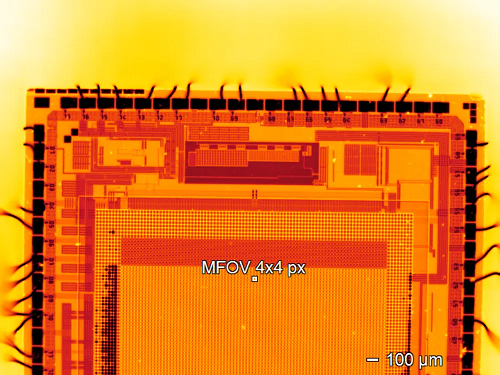
적외선 현미경은 적외선을 사용하여 미세 샘플을 시각화하고 분석하도록 설계된 광학 기기입니다. 이는 적외선 분광학과 현미경의 원리를 결합하여 특수 적외선 현미경 광학을 활용함으로써 높은 공간 해상도와 정밀한 이미징을 실현합니다. 적외선 현미경은 재료의 화학 조성, 분자 구조 및 열적 특성을 미시적 수준에서 연구할 수 있게 하며, 재료과학, 생물학, 법과학 등 다양한 분야에서 가시광 현미경으로는 얻을 수 없는 세부 정보를 제공하는 데 널리 사용됩니다.
적외선 현미경의 주요 과제는 적외선 현미경 광학의 복잡성에 있습니다. 적외선 스펙트럼에서 높은 해상도와 정확한 이미징을 달성하는 것은 가시광 스펙트럼보다 더 어렵습니다. 적외선 파장은 더 길기 때문에 회절 한계에 영향을 미쳐 달성 가능한 공간 해상도를 저하시킵니다. 광학 소자는 수차를 최소화하고 특정 적외선 파장에서 높은 투과율을 유지하기 위해 정밀하게 설계되고 제작되어야 합니다.
또한 종종 비냉각 마이크로볼로미터인 적외선 검출기들 역시 자체적인 제약을 가집니다. 더 작은 픽셀 피치는 더 높은 해상도에 유리하지만 각 픽셀의 유효 흡수 면적을 줄여 감도와 신호대잡음비에 영향을 미칩니다. 픽셀 크기와 검출기 감도 사이의 균형을 유지하는 것이 정확한 측정을 위해 중요합니다. 성능 향상을 위해 고급 재료와 다층 구조가 개발되고 있습니다.
또 다른 중요한 문제는 광학이 부과하는 회절 한계입니다. 적외선이 현미경 광학을 통과할 때 회절로 인해 빛이 퍼져 에어리 디스크 패턴을 생성합니다. 이러한 퍼짐은 미세한 세부를 분해할 수 있는 능력을 제한하고, 인접 지점으로부터의 회절 패턴이 겹쳐 가까이 있는 특징을 구별하기 어렵게 만들 수 있습니다.
An infrared microscope is an optical instrument designed to visualize and analyze microscopic samples using infrared radiation. It combines the principles of infrared spectroscopy and microscopy, utilizing specialized infrared microscope optics to achieve high spatial resolution and precise imaging. Infrared microscopes enable the study of chemical compositions, molecular structures, and thermal properties of materials at a microscopic level. They are widely used in various fields, including materials science, biology, and forensic analysis, providing detailed information that is not accessible with visible light microscopy.
The primary challenge in infrared microscopy lies in the complexity of infrared microscope optics. Achieving high resolution and accurate imaging in the infrared spectrum is more difficult than in the visible spectrum. Infrared wavelengths are longer, which impacts the diffraction limit and reduces the achievable spatial resolution. The optical elements must be precisely designed and fabricated to minimize aberrations and maintain high transmittance for specific infrared wavelengths.
Moreover, infrared detectors, often uncooled microbolometers, have their own set of limitations. Smaller pixel pitches, while beneficial for higher resolution, reduce the effective absorption area of each pixel, affecting sensitivity and signal-to-noise ratio. Maintaining the balance between pixel size and detector sensitivity is crucial for accurate measurements. Advanced materials and multilayer structures are being developed to enhance detector performance.
Another significant issue is the diffraction limit imposed by the optics. As infrared light passes through the microscope optics, diffraction causes the light to spread, creating an Airy disk pattern. This spreading limits the ability to resolve fine details and can result in overlapping diffraction patterns from adjacent points, making it challenging to distinguish between closely spaced features.