



F-number : F-넘버(조리개비)
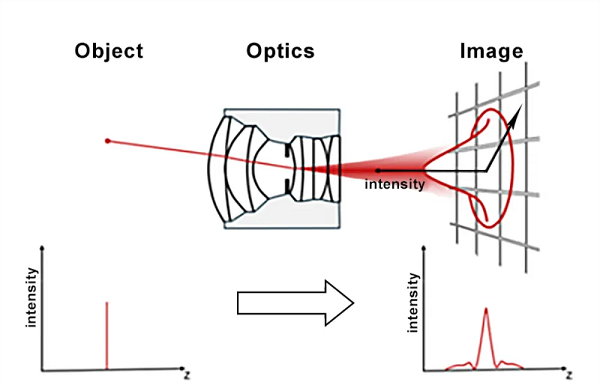
F-넘버(F-number)는 광학 시스템을 설명하는 핵심적인 파라미터입니다. 이는 초점거리와 유효 조리개 직경(또는 입사 동공) 간의 비율로 정의됩니다. 사진 분야에서 유래한 개념이지만, F-넘버는 피사계 심도, 광학 해상도, 그리고 검출기에 전달되는 광량 등 다양한 광학적 특성에 중요한 영향을 미칩니다. 사진에서는 조리개가 가변적인 경우가 많아 이러한 특성에 큰 영향을 줍니다.
조리개가 작아질수록, 즉 F-넘버가 커질수록 일반적으로 검출기에 도달하는 빛의 양은 줄어듭니다. 이로 인해 프레임 속도를 낮춰야 하거나 노이즈가 증가할 수 있습니다. 조리개 크기와 노출 시간 또는 프레임 속도 간의 이러한 관계 때문에, F-넘버는 흔히 “느린(slow)” 렌즈(F-넘버가 큰 경우)와 “빠른(fast)” 렌즈(F-넘버가 작은 경우)로 표현됩니다.
F-넘버에 √2를 곱하면 조리개 면적은 절반으로 줄어들고, 이에 따라 전달되는 광량도 초기 값의 절반이 됩니다. 고온계나 열화상 카메라와 같은 열화상(서모그래피) 분야에서는 F-넘버가 열 분해능에 큰 영향을 미치며, 이는 NETD ∼ F²의 관계로 표현됩니다. 이는 F-넘버가 프레임 속도와 열 분해능 모두에 중요한 영향을 준다는 점을 보여줍니다.
특히 비냉각 초점면 어레이에서 픽셀 크기가 12 µm와 같이 작은 장파장 적외선(LWIR) 응용 분야에서는, 작은 표적에 대해서도 경쟁력 있는 광학 해상도와 정확한 온도 측정을 달성하기 위해 낮은 F-넘버가 필수적입니다. 이러한 경우 F-넘버는 적외선 카메라의 성능을 설명하는 가장 중요한 값이 됩니다. 목표는 회절 한계(optical diffraction limit)에 도달하는 광학계를 구현하여, 검출기 상에 가능한 한 최상의 패턴, 즉 에어리 디스크(Airy disk)를 형성하는 것입니다. 특정 파장에서 스폿 패턴의 직경을 합리적인 수준으로 줄이는 유일한 방법은 낮은 F-값을 사용하는 것입니다.
그러나 낮은 F-넘버는 영상 흐림을 유발하거나 수차를 증가시킬 수 있다는 점에도 유의해야 합니다. 따라서 렌즈 시스템의 광학 설계와 제조 품질이 충분히 우수한 경우에만, 낮은 F-넘버가 광학 해상도 또는 D:S 비를 실제로 향상시킬 수 있습니다.
또한 F-넘버는 피사계 심도에도 영향을 미치며, F-넘버가 낮을수록 피사계 심도는 증가합니다. 이는 특히 작은 표적을 대상으로 서로 다른 거리에서 온도를 정확히 측정해야 하는 경우 문제를 복잡하게 만들 수 있습니다. 초점 조정을 통해 이러한 문제를 해결할 수는 있지만 추가적인 작업이 필요합니다. 따라서 특정 작업에 대한 적합성을 평가할 때는 해당 열화상 카메라의 피사계 심도 특성을 함께 고려하는 것이 바람직합니다.
The F-number is a key parameter that describes an optics system. It is defined as the ratio of the focal length to the effective aperture diameter (or entrance pupil). Historically associated with photography, the F-number plays a crucial role in various optical properties, including depth of field, optical resolution, and the amount of light transmitted to the detector. In photography, the aperture is often variable, significantly affecting these characteristics.
A smaller aperture, which corresponds to a higher F-number, usually results in less light reaching the detector. This may require lower frame rates or produce higher noise. This relationship between aperture size and exposure time or frame rate is the reason why F-numbers are referred to as “slow” (higher F-number) or “fast” (lower F-number).
Multiplying the F-Number with 2–√
will lead to half of the aperture’s area, and the light transfer will be half of the initial amount. In the context of thermography, such as with pyrometers or thermal imaging cameras, the F-number has a significant influence on thermal resolution, as referred to in the relation NETD ∼F2
. This highlights the impact of the F-number on both frame rate and thermal resolution in thermal imaging.
Particularly for long-wave infrared (LWIR) applications with small detector sizes, such as 12 µm pixels for uncooled focal plane arrays, a low F-number is essential for achieving competitive optical resolution and accurate temperature measurement even for small targets. In that case, the F-number is the most important value to describe the performance of infrared cameras. The aim is to create diffraction-limited optics that generate the best possible pattern on the detector, the so-called Airy disk. At a certain wavelength, a low F-value is the only way to reduce the spot pattern to a reasonable diameter.
However, it’s important to note that a low F-number can also lead to image blurring and the introduction of aberrations. For that reason, a low F-number enhances the optical resolution or D:S ratio only if the optics design and manufacturing quality of the lens system are sufficiently high.
Additionally, the F-number has an impact on the depth of field, which increases with lower F-numbers. This can complicate the accurate measurement of temperatures at varying distances, especially for small targets. Adjusting the focus could fix this issue but would require additional effort. It is advisable to consider the depth of field characteristics of a particular thermal imaging camera when assessing its suitability for specific tasks.