



Cooled Thermal Imaging Cameras : 냉각형 열화상 카메라
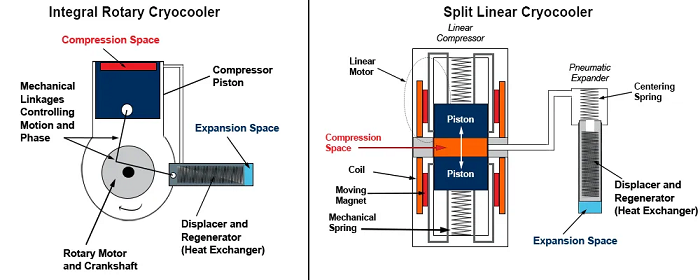
극저온 냉각기를 사용하는 열화상 카메라는 열화상 코어를 영하 196 °C(섭씨 -321 °F)까지 냉각할 수 있는 고급 장비입니다. 이러한 냉각 과정은 카메라의 감도와 정확도를 크게 향상시켜, 매우 미세한 온도 차이까지 감지하고 고해상도의 열화상 이미지를 생성할 수 있게 합니다. 냉각형 열화상 카메라는 일반적으로 3~5 µm 파장을 사용하는 중적외선(MWIR) 영역에서 동작합니다.
이러한 시스템은 물체에서 방출되는 복사열을 감지합니다. 카메라 내부에서 발생하는 추가적인 열은 불필요한 배경 잡음을 유발할 수 있으며, 이는 열화상 이미지의 선명도와 정확도를 저하시킵니다. 냉각형 적외선 카메라는 극저온 냉각기를 사용해 센서 온도를 극저온 수준으로 낮춤으로써 이러한 내부 열 잡음을 최소화합니다. 이러한 냉각 메커니즘 덕분에 냉각형 적외선 카메라는 대상과 배경 사이의 아주 미세한 온도 차이까지 감지할 수 있습니다. 극저온 냉각기는 보통 약 77 켈빈(−196 °C 또는 −321 °F)을 유지하기 위해 지속적으로 작동합니다. 이러한 연속 작동은 정밀한 열화상을 구현하는 데 필요한 높은 감도를 확보하는 데 중요합니다. 냉각기는 대개 휘발성 가스로 채워져 있으며, 극히 엄격한 기계적 공차로 제작되어야 합니다. 그러나 시간이 지남에 따라 마모가 발생하고, 수천 시간 정도의 운전 후에는 유지보수나 교체가 필요하게 됩니다.
냉각형 적외선 카메라의 가장 큰 장점은 빠른 속도에서도 매우 작은 온도 차이에 대한 높은 감도를 제공한다는 점입니다. 이를 통해 극히 미약한 열적 이상까지도 감지할 수 있습니다. 냉각형 카메라는 신호 대 잡음비를 저하시키지 않으면서 더 크고 많은 광학 요소를 포함한 렌즈를 사용할 수 있어, 더 높은 배율과 뛰어난 영상 세부 표현을 구현할 수 있습니다. 이러한 카메라는 미세한 온도 차이의 검출, 빠른 응답 속도, 또는 고속 열 현상의 관측이 요구되는 응용 분야에 매우 적합합니다.
그럼에도 불구하고 냉각형 적외선 카메라를 사용하는 데에는 상당한 단점이 존재합니다. 가장 큰 단점 중 하나는 높은 비용입니다. 극저온 냉각기, 특수 검출기, 대형 광학계의 통합과 정밀한 제조 공정이 요구되기 때문에 비냉각식 열화상 카메라에 비해 가격이 크게 상승합니다. 이러한 카메라에 사용되는 극저온 냉각기는 구동 부품을 포함하고 있으며, 냉각 매질이 시간이 지남에 따라 서서히 누설되므로 주기적인 유지보수와 냉각기 교체가 필요합니다. 이러한 유지보수는 비용과 시간이 모두 많이 소요됩니다. 극저온 냉각 시스템은 카메라의 구조를 복잡하게 만들어 기계적 고장에 더 취약하게 합니다. 또한 씰(seal)과 듀어(dewar) 어셈블리 역시 고장이 발생할 수 있어 추가적인 수리가 필요합니다. 낮은 동작 온도를 유지하기 위해 극저온 냉각기는 이러한 극저온 상태에 도달하고 유지하기 위해 지속적으로 작동해야 합니다. 높은 비용, 유지보수 요구, 복잡성, 연속 작동의 필요성이라는 단점에도 불구하고, 냉각형 적외선 카메라는 최고 수준의 열화상 성능이 요구되는 과학 및 군사 분야에서는 여전히 매우 중요한 장비로 사용되고 있습니다.
Thermal imaging cameras that use a cryogenic cooler are advanced devices capable of cooling the thermal image core to temperatures as low as -196 °C (-321 °F). This cooling process significantly enhances the camera’s sensitivity and accuracy, allowing it to detect minute temperature differences and produce highly detailed thermal images. Cooled thermal cameras typically operate in the mid-wave infrared (MWIR) range, using 3-5 µm wavelengths.
These systems detect radiated heat from objects. Any additional heat within the camera itself can introduce unwanted background noise, which reduces the clarity and accuracy of the thermal images. Cooled infrared cameras minimize this internal thermal noise by using a cryocooler to lower the sensor temperature to cryogenic levels. This cooling mechanism allows the cooled infrared camera to detect even the smallest temperature variations between the target and its background. The cryocooler runs continuously to maintain the low temperature, typically around 77° Kelvin (-196 °C or -321 °F). This continuous operation is important for achieving the high sensitivity required for precise thermal imaging. The cooler, often filled with volatile gas, needs to be built to extremely close mechanical tolerances. Unfortunately, it wears out over time and eventually requires maintenance or replacement after a couple of thousand hours of operation.
The primary advantage of cooled infrared cameras is their enhanced sensitivity to small temperature differences at fast speeds. This allows them to detect even the faintest thermal anomalies. Cooled cameras can use larger lenses with more optical elements without degrading the signal-to-noise ratio, resulting in higher magnification and better image detail. These cameras are ideal for applications that require the detection of minute temperature differences, fast response times, or high-speed thermal phenomena.
Nevertheless, there are significant drawbacks to using cooled infrared cameras. One of the most considerable disadvantages is their high cost. Integrating a cryogenic cooler, a special detector, large optics, and the need for precise manufacturing significantly increases the price compared to uncooled thermal cameras. The cryocoolers used in these cameras have moving parts and a cooling medium that slowly leaks over time, necessitating periodic maintenance and replacement of the cooler. This maintenance can be costly and time-consuming. The cryogenic cooling system adds complexity to the camera, making it more prone to mechanical failures. The seals and dewar assemblies can also fail, necessitating additional repairs. To maintain their low operating temperature, the cryocooler must run continuously to achieve such cryogenic temperatures. Despite the disadvantages, including higher cost, maintenance requirements, complexity, and continuous operation needs, cooled infrared cameras remain valuable, especially in scientific and military applications that require the highest levels of thermal imaging performance.