



CO₂ Filter : 이산화탄소 필터
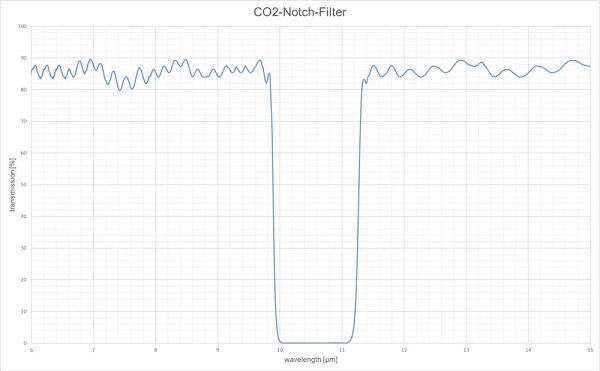
적외선 CO₂ 필터는 이산화탄소(CO₂)의 흡수 대역에 해당하는 특정 적외선 파장을 선택적으로 차단하도록 설계된 특수 광학 부품입니다. 적외선 카메라의 맥락에서 이러한 필터는 CO₂ 레이저 방출로 인해 발생할 수 있는 손상으로부터 카메라의 민감한 마이크로볼로미터 검출기를 보호하는 데 매우 중요합니다. 대부분의 CO₂ 레이저는 전자기 스펙트럼의 적외선 영역에서 10.6 마이크로미터(µm) 파장에서 동작하지만, 9.6 µm와 같은 다른 파장에서 작동할 수도 있습니다. 이 중 10.6 µm 파장이 다양한 응용 분야에서 가장 일반적으로 사용됩니다.
적외선 카메라, 특히 비냉각 마이크로볼로미터를 사용하는 카메라는 물체에서 방출되는 적외선 복사를 감지하고 측정하여 온도 분포를 시각화하도록 설계되어 있습니다. 그러나 특히 10.6 µm 파장의 CO₂ 레이저 광은 검출기에 직접 도달할 경우 마이크로볼로미터를 손상시킬 만큼 강도가 높을 수 있습니다. 적외선 CO₂ 필터는 CO₂ 레이저에서 방출되는 특정 파장을 차단함으로써 이러한 문제를 해결하고, 카메라의 민감한 내부 부품을 보호합니다.
적외선 CO₂ 필터는 대부분의 적외선에는 투과성을 가지면서도 CO₂ 레이저 파장은 흡수하거나 반사하도록 설계된 재료로 제작됩니다. 일반적으로 게르마늄이나 셀레늄화아연(ZnSe)과 같은 재료가 사용되며, 필요한 정밀한 필터링 특성을 구현하기 위해 유전체 박막 코팅이 적용됩니다. 이러한 코팅은 높은 정밀도와 성능을 확보하기 위해 보통 진공 증착 공정을 통해 형성됩니다.
An infrared CO2 filter is a specialized optical component designed to selectively block specific wavelengths of infrared light associated with the absorption bands of carbon dioxide (CO2). In the context of an infrared camera, these filters are crucial for protecting the camera’s sensitive microbolometer detectors from potential damage caused by CO2 laser emissions. Most CO2 lasers operate at a wavelength of 10.6 micrometers (µm) in the infrared region of the electromagnetic spectrum, though they can also function at other wavelengths, such as 9.6 µm. The 10.6 µm wavelength is the most commonly used in various applications.
Infrared cameras, particularly those using uncooled microbolometers, are designed to detect and measure infrared radiation emitted by objects to visualize temperature distributions. However, CO2 laser light, particularly at 10.6 µm, can be intense enough to damage the microbolometer if it directly reaches the detector. The infrared CO2 filter addresses this issue by blocking the specific wavelengths emitted by CO2 lasers, thereby protecting the camera’s delicate components.
The construction of an infrared CO2 filter involves materials that are transparent to most infrared light but are engineered to absorb or reflect the CO2 laser wavelengths. Common materials include germanium or zinc selenide, coated with dielectric thin films that provide the precise filtering properties needed. These coatings are typically applied using vacuum deposition techniques to ensure high accuracy and performance.