



Vertical Field of View (VFOV) : 수직 시야각 (VFOV)
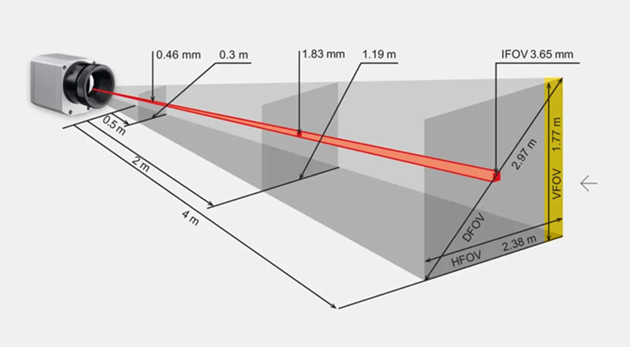
일반적으로 기기의 시야각(FOV)은 장치가 민감하게 반응하고 대상 물체를 감지할 수 있는 각도로 설명됩니다. 파이로미터의 경우 이는 종종 온도계의 측정 지점 크기(측정 스팟 크기)로 정의됩니다. 열화상 분야에서는 카메라의 FOV가 카메라로 이미지화할 수 있는 장면의 관측 가능한 영역을 결정합니다.
카메라의 FOV는 일반적으로 도(degree)로 표현되며, 열화상 카메라의 광학 구성과 검출기 크기에 따라 달라집니다. FOV는 센서 크기와 카메라 광학의 초점거리 f의 비율로 정의됩니다:
FOV = 2∙arctan(sensor size / 2f) ≈ sensor size / f
센서 포맷과 관련하여 FOV는 수평 시야각(HFOV)과 수직 시야각(VFOV)으로 표현할 수 있습니다.
대부분의 경우 물체와의 거리(대상 거리)가 FOV 선택을 결정합니다. 장거리 응용에서는 좁은 FOV(텔레옵틱스, TeleOptics)를 선택할 수 있으며, 이를 통해 장거리에서도 작은 물체를 감지할 수 있습니다. 짧은 거리에서 좁은 FOV를 사용하는 것도 가능합니다. 짧은 거리와 좁은 FOV의 결합은 대상의 높은 배율을 가져옵니다. 고급 응용에서는 8 µm – 14 µm 파장대 사용 시에도 수 마이크로미터 크기의 작은 물체를 감지할 수 있도록 현미경 광학이 필요합니다.
넓은 시야각(FOV)을 가진 열화상 카메라는 더 넓은 영역을 촬영할 수 있어 일반 감시 및 광범위한 지역의 온도 분포를 신속하게 평가하는 데 유리합니다. 예를 들어 제어반과 같은 전기 설비를 점검할 때, 공간이 제한된 경우에도 넓은 FOV는 전기적 결함을 식별할 수 있게 해줍니다. 광각 광학계는 화재 탐지와 같은 대규모 환경 모니터링에도 활용될 수 있습니다. 온도 이상을 감지하기 위해 열화상 이미지를 핫스팟 감지 알고리즘으로 분석하여 점검 보고서를 생성하거나 공정 경보를 직접 트리거할 수 있습니다.
시야각(FOV)과 광학 해상도:
이러한 FOV 정의에 더해, 공간 해상도인 순간 시야각(IFOV)을 고려해야 작은 물체의 온도 측정을 명확히 할 수 있습니다. IFOV는 센서 어레이의 한 픽셀을 나타내며 분해 가능한 최소 물체 크기를 결정합니다. 정확한 온도 측정을 위해서는 대상 크기가 IFOV보다 커야 합니다. 일반적으로 물체 크기는 적어도 3×3 픽셀 이상이어야 하며, 이는 측정 시야각(MFOV)을 정의합니다.
사용자는 특정 거리에서 시야각을 mm 또는 m 단위로 알고 싶어하는 경우가 많습니다. FOV 계산기는 사용자가 사용 중인 카메라/광학계를 입력할 수 있게 하며 HFOV, VFOV, IFOV 및 MFOV와 같은 모든 필요한 FOV 데이터를 표시합니다.
열화상 카메라에서 FOV 선택은 작은 세부를 구별하는 능력을 의미하는 카메라의 광학 해상도와 밀접하게 연관되어 있습니다. 광학 해상도(또는 공간 해상도)가 높은 카메라는 더 미세한 세부를 분해할 수 있어 작은 물체나 먼 물체를 검사할 때 중요합니다. 이러한 광학 해상도는 일반적으로 시야각이 좁은 카메라에서 더 높습니다. 따라서 FOV와 광학 해상도 간의 균형은 열화상에서 중요한 고려 사항으로, 생성되는 열화상 결과의 품질과 사용성 모두에 영향을 미칩니다.
The vertical field of view (VFOV) describes the height of the area of a scene that can be observed by the camera. A sensor in rectangular format is most commonly used. For this reason, the height of the sensor together with the focal length of the lens defines the vertical FOV. The horizontal and vertical image angles (width and height of the sensor) determine the total image angle of the camera. These two values result in the diagonal field of view (DFOV). In most cases, the larger side of the rectangular camera is aligned with the horizon, while the vertical FOV is oriented perpendicular to the earth’s surface.
In general, the field of view (FOV) of an instrument is usually described by the angle at which the device is sensitive and can detect the target object. For pyrometers, it is often defined as the measurement spot size of the thermometer. In the field of thermography, the FOV of a camera determines the observable area of a scene that can be imaged by the camera.
The camera FOV is typically expressed in degrees and depends on the configuration of optics and detector size of the thermal imaging camera. The FOV is defined by the ratio of the sensor size and the focal length f of the camera optics:
FOV=2∙arctan (sensor size/2f) ≈ sensor size/f
Related to the sensor format, the FOV can be expressed by a horizontal field of view (HFOV) and a vertical field of view (VFOV).
In most cases, the object distance determines the choice of the FOV. For long-range applications, a narrow FOV (TeleOptics) can be selected, which enables the detection of small objects even at long distances. The use of a narrow FOV at a short distance is also possible. The short distance in combination with the narrow FOV leads to a high magnification of the target. For advanced applications, microscope optics are required to enable the detection of small objects with a size of a few micrometers, even when using the 8 µm – 14 µm waveband.
With a wide FOV, the thermal imaging camera can capture a larger area, which can be beneficial for general surveillance and rapid assessment of temperature distribution over wide areas. When inspecting electrical installations such as control cabinets, for example, a wide FOV enables the identification of electrical defects when only confined space is available. Wide-angle optics can also be used for large-scale environmental monitoring, such as fire detection. To detect temperature anomalies, the thermographic image can be analyzed with a hotspot detection algorithm to generate inspection reports or directly trigger a process alarm.
Field of view and optical resolution:
In addition to these FOV definitions, the spatial resolution, the so-called instantaneous field of view (IFOV), must be taken into account to clarify the temperature measurement of small objects. The IFOV represents one pixel of the sensor array and determines the smallest resolvable object size. For accurate temperature measurements, the target size must be larger than the IFOV. The typical size of objects must be at least 3×3 pixels, which defines the measurement field of view (MFOV).
Often the user is interested in a specific distance and wants to know the FOV in mm or m. The FOV calculator allows the user to enter the used camera/optics and displays all necessary FOV data like HFOV, VFOV, IFOV, and MFOV.
The selection of the FOV in thermography cameras is closely linked to the camera’s optical resolution, which refers to its ability to distinguish small details. A camera with high optical resolution (or spatial resolution) can resolve finer details, which is critical when examining small or distant objects. This optical resolution is typically higher in cameras with narrower fields of view. Therefore, the trade-off between FOV and optical resolution is a key consideration in thermography, affecting both the quality and usability of the thermal imaging results produced.