



Ambient Derating : 주변 온도 디레이팅
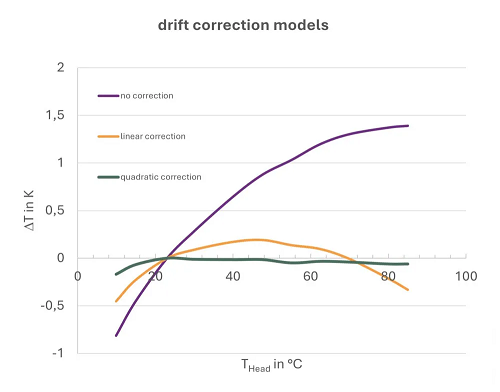
주변 온도 디레이팅(Ambient derating)은 측정 장치의 신호가 주변 온도에 어느 정도 영향을 받아 변하는 현상을 설명합니다. 이러한 효과는 여러 가지 원인에 의해 발생하며, 그 영향의 크기는 사용된 전자 회로와 검출기 기술에 따라 달라집니다.
일반적으로 장치 온도에 따른 이러한 신호 드리프트는 세 가지 원인으로 설명할 수 있습니다. 첫째, 모든 전자 부품은 고유의 온도 계수를 가지며, 이는 특히 신호 강도가 낮을 때 두드러지게 나타납니다. 장치 제조사는 적절한 부품을 선택함으로써 이 영향을 어느 정도 제어할 수 있습니다. 둘째, 스펙트럼 범위를 정확하게 정의하기 위해 스펙트럴 필터가 자주 사용됩니다. 이러한 필터는 원하는 투과 특성을 얻기 위해 서로 다른 재질의 매우 얇은 여러 층으로 구성되며, 보강 간섭과 상쇄 간섭의 원리를 이용합니다. 온도 변화는 이 다층 구조와 투과 특성에 영향을 미치며, 특히 측정 범위 중앙에 해당하는 온도 영역에서 그 영향이 나타납니다. 다만 이 효과는 비교적 작은 편입니다. 셋째, 사용된 기술에 따라 검출기의 감도는 주변 온도의 영향을 서로 다른 정도로 받습니다. 예를 들어, 주변 온도가 23 °C에서 70 °C로 상승할 경우, 검출기 재질에 따라 감도가 약 3%에서 최대 50%까지 변할 수 있습니다.
대부분의 제조사는 장치 내부 온도 변화로 인한 신호 드리프트를 최소화하기 위해 노력합니다. 경우에 따라서는 검출기 온도를 특정 값으로 유지하기 위해 가열 또는 냉각과 같은 기술적 방법을 적용해 온도를 안정화하기도 합니다. 또 다른 방법으로는 검출기 온도를 측정하고, 이에 따라 발생하는 신호 변동을 장치 펌웨어에 저장된 물리적 모델을 이용해 보정할 수도 있습니다.
이후 남게 되는 주변 온도 디레이팅의 정도는 보정 모델의 품질에 따라 결정됩니다. 예를 들어, 비선형적인 드리프트 거동을 선형 보정 계산으로 처리할 경우, 장치 내부 온도에 따른 측정 오차는 매우 제한된 주변 온도 범위에서만 최소화되거나 불규칙한 특성을 보일 수 있습니다. 여기서 설명한 효과는 열적으로 정상 상태에 있는 시스템을 기준으로 합니다. 반면, 주변 온도가 급격히 변할 때 표시값이 요동치는 현상은 열 충격(thermal shock)이라고 합니다.
Ambient derating describes the phenomenon where the measuring device signal depends to a certain extent on the ambient temperature. This effect has various causes, and its extent depends on the electronics used and the detector technology.
In general, this signal drift as a function of the device temperature can have three causes. Firstly, each electronic component has its own temperature coefficient, which is particularly noticeable at low signal strengths. Device manufacturers can influence this effect by selecting appropriate components. Secondly, spectral filters are often used to precisely define the spectral range. These filters usually consist of many thin layers of different materials to achieve the desired transmission characteristics through constructive and destructive interference. Temperature changes influence this layer system and its transmission properties, particularly affecting temperatures in the center of the measurement range. This effect, however, is relatively small. Thirdly, depending on the technology, the sensitivity of the detector is influenced to varying degrees by the ambient temperature. For example, if the ambient temperature increases from 23 °C to 70 °C, the sensitivity can change from 3% to 50%, depending on the detector material.
Most manufacturers strive to minimize signal drift due to intrinsic temperature changes. In some cases, the detector temperature is stabilized by technical measures, either by heating or cooling to a defined temperature. Alternatively, the detector temperature can be measured, and any signal fluctuations dependent on this can be compensated for by a physical model stored in the device firmware.
The extent of the remaining ambient derating then depends on the quality of the compensatory model. For example, if a non-linear drift behavior is addressed with a linear correction calculation, the measurement error as a function of the intrinsic temperature can only be minimized in a small ambient temperature interval or exhibit erratic characteristics. The effect described here refers to thermally steady-state systems. Fluctuations in the display due to rapid ambient temperature changes are referred to as thermal shock.