



Thermal Image Merging : 열화상 합성
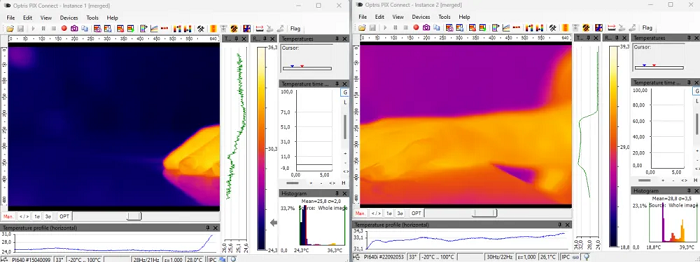
이미지 처리에서는 종종 더 넓은 시야를 만들기 위해 적외선 이미지를 합성해야 하며, 이는 여러 개의 겹치는 열화상 이미지를 하나의 파노라마 이미지로 결합하는 작업을 포함한다. 이 기법은 산업 검사, 환경 모니터링, 건물 진단과 같이 넓은 시야가 필요한 응용에서 필수적이다.
과정은 관심 영역의 여러 겹치는 적외선 이미지를 촬영하는 것부터 시작된다. 각 이미지는 인접 이미지들 간에 적절한 겹침이 생기도록 약간 다른 위치에서 촬영된다. 이러한 겹침은 이미지 스티칭 소프트웨어가 이미지를 정확히 정렬하고 합성하는 데 매우 중요하다. 고급 이미지 처리 알고리즘은 겹치는 영역에서 고유한 점이나 패턴을 식별하고 이를 이미지 간에 일치시켜 이미지를 정렬한다.
이미지가 정렬되면 소프트웨어는 이를 매끄럽게 블렌딩하여 일관된 파노라마를 만든다. 여기에는 이미지들 간의 강도 수준을 조정하고 온도 차이를 보정하여 균일성을 확보하는 작업이 포함된다. 그 결과는 개별 이미지보다 훨씬 넓은 시야를 제공하는 합성 열화상으로, 해당 영역의 포괄적인 열 지도를 제공한다.
Image processing often requires merging infrared images to create a larger field of view, which involves combining multiple overlapping thermal images into a single panoramic image. This technique is essential in applications that require a broad perspective, such as industrial inspections, environmental monitoring, and building diagnostics.
The process begins with capturing several overlapping infrared images of the area of interest. Each image is taken from slightly different positions to ensure adequate overlap between adjacent images. This overlap is crucial for the image stitching software to accurately align and merge the images. Advanced image processing algorithms then come into play, aligning these images by identifying unique points or patterns in the overlapping regions and matching them across images.
Once the images are aligned, the software
blends them seamlessly to create a cohesive panorama. This involves adjusting
the intensity levels and correcting any temperature variations between the
images to ensure uniformity. The result is a composite thermal image that
offers a much larger field of view than any individual image, providing a
comprehensive thermal map of the area.