



Stefan-Boltzmann Law : 스테판-볼츠만 법칙
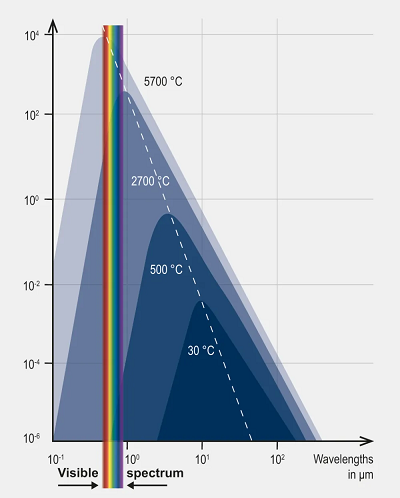
스테판-볼츠만 법칙은 표면적 A를 가진 흑체의 절대온도와 모든 방향으로 방출되는 전체 복사 전력(단위: W) 간의 관계를 설명합니다.
P=σ⋅A⋅T4
스테판-볼츠만 상수와 함께: σ=5,670374419…⋅10−8Wm2K4
이 값은 1879년 Josef Stefan에 의해 실험적으로 발견된 후, 1884년 Ludwig Boltzmann이 고전 열역학 및 전자기학 법칙으로부터 유도해낼 수 있었습니다. 이후 Max Planck는 플랑크의 복사 법칙을 모든 파장과 모든 공간 방향에 대해 적분하여 이 상수를 다른 자연 상수들로 표현할 수 있도록 했습니다.
회색체의 경우, 즉 이상적인 흑체에 비해 방사율이 1보다 작지만 모든 파장에 대해 일정한 열 방출체의 경우, 이 법칙은 다음과 같이 변경됩니다: T
The Stefan-Boltzmann law describes the relationship between the absolute temperature of a black body with surface A and the total radiant power (in W) emitted in all spatial direction.
P=σ⋅A⋅T4
with the Stefan-Boltzmann constant: σ=5,670374419…⋅10−8Wm2K4
After it was discovered experimentally by Josef Stefan in 1879, Ludwig Boltzmann was able to derive it from the laws of classical thermodynamics and electrodynamics in 1884. Later, Max Planck was able to derive it by integrating his Planck’s law of radiation over all wavelengths and all spatial directions. This allowed the Stefan-Boltzmann constant to be expressed in terms of other natural constants:
For a gray body, i.e. thermal emitters that have an emissivity of less than 1 compared to the ideal black body, but which is constant for all wavelengths, this law changes to: T