



Size of Source Effect : 소스 크기 효과
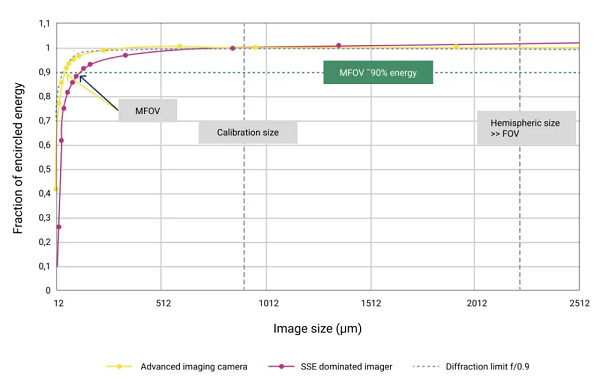
온도 측정 분야에서의 소스 크기 효과(Size of Source Effect, SSE)는 장치 검출기에 추가적인 복사 영향이 발생하는 중요한 현상입니다. 이는 정밀 온도 측정에 있어서 중요한 요소입니다.
플로미터(pyrometers)와 열화상 카메라(thermographic cameras) 모두 특정 거리와 특정 복사원 직경에서 보정(calibration)되며, 이는 보정 기하학(calibration geometry)을 정의합니다. 실제로 측정 대상의 크기는 일반적으로 보정 소스의 크기와 같지 않습니다. 이 사실을 정량화하기 위해 실험실 조건에서 SSE를 측정하여 실제 온도 측정 적용에 대한 정보를 얻을 수 있습니다. 이를 위해 복사원 크기를 변화시키면서 측정된 온도 값을 추적합니다.
정의상 방사체(radiator)의 직경은 측정 스팟보다 훨씬 크며, 이는 보통 적당한 보정 거리로 달성됩니다. 복사원 크기가 증가하면 일반적으로 추가 복사가 발생하여 측정된 온도가 상승합니다. 예를 들어 방사체의 직경을 50 mm에서 100 mm로 두 배로 늘리면 표면적은 4배로 증가하여 측정 장치로 들어오는 복사가 증가하고 더 높은 온도 측정값을 초래합니다. 최대 온도 값은 반구형 방사원(half-space)이 방출하는 복사에 해당합니다. 이러한 더 큰 복사원에 대해서는 SSE가 광학 시스템 내의 반사 및 산란 효과에 의해 지배됩니다.
위에서 설명한 증가와는 대조적으로, 보정 기하학의 크기로 인해 소스 직경이 감소하면 검출기에서의 신호 레벨이 감소합니다. 결과적으로 플로미터의 측정 스팟은 에너지의 90%로 정의되며, 이는 정확한 온도 측정을 위한 최소 스팟 크기 직경을 나타냅니다. 열화상 측정의 경우 최소 스팟 크기는 MFOV(Measurement Field of View)로 설명되며, 일반적으로 3×3 픽셀을 나타냅니다. MFOV 크기의 작은 대상에 대해 SSE는 렌즈 수차와 회절에 의해 지배됩니다. 장치의 회절 한계는 순수하게 파장과 F-수(F-number)에 따라 달라지며, 이는 불완전한 광학 시스템이 아닌 물리적 회절 한계 때문입니다. 이러한 경우 복사원 직경을 늘리거나 줄이는 효과를 고려하는 것이 중요하며, 직경을 감소시키면 온도 측정에서 더 큰 편차가 발생하는 경우가 많습니다.
측정 거리는 변경되지 않음을 유의하십시오. 유일한 변경은 복사원 크기를 변화시키는
것입니다. 실제 적용에서는 물론 두 변화가 동시에 발생할 수 있으며 이를 고려해야 합니다.
The Size of Source Effect (SSE) in the field of temperature measurement is an important phenomenon that describes an additional radiation influence on the device detector. It is a crucial factor for precision temperature measurement.
Both pyrometers and thermographic cameras are calibrated at a specific distance and with a specific radiation source diameter, which defines the calibration geometry. In practice, the target is usually not the same size as the calibration source. To quantify this fact, we can measure the SSE under laboratory conditions to obtain information about a real temperature measurement application. To do this, the measured temperature value is tracked while varying the size of the radiation source.
By definition, the radiator’s diameter is much larger than the measuring spot, typically achieved through moderate calibration distances. Increasing the radiation source’s size generally results in additional radiation, leading to a higher measured temperature. If the diameter of the radiator is doubled from 50 mm to 100 mm, for example, the surface area increases by a factor of four, which increases the radiation entering the measuring device and results in a higher temperature reading. The maximum temperature value corresponds to the radiation emitted by a hemispherical radiation source (half-space). For these larger radiation sources, the SSE is dominated by reflection and scattering effects within the optical system.
In contrast to the above increase, a reduction in the source diameter due to the size of the calibration geometry leads to a reduction in the signal level on the detector. Consequently, the measurement spot for pyrometers is defined by 90% of the energy, which represents the minimum spot size diameter for accurate temperature measurement. For thermal imaging, the minimum spot size is described by the MFOV (Measurement Field of View), which typically represents 3×3 pixels. For small targets the size of the MFOV, the SSE is dominated by lens aberration and diffraction. The diffraction limit of the device depends purely on the wavelength and F-number, which is due to the physical diffraction limit rather than an imperfect optical system. In such cases, it is essential to consider the effects of increasing or decreasing the diameter of the radiation source, as a reduction often leads to a greater deviation in the temperature measurement.
Please note that the measuring distance is not changed. The only change is made by varying the size of the radiation source. In a real application, both changes can, of course, occur simultaneously and should be taken into account.