



Scatter : 산란
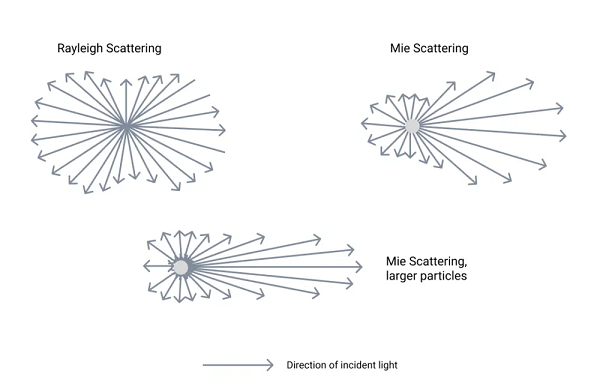
산란은 빛이 예측된 경로에서 벗어나 직진 궤적이 변경되는 현상입니다. 이로 인해 산란된 빛이 검출기에 도달하여 추가적인 신호 세기를 유발할 수 있으므로, 온도 측정 분야에서 중요한 문제로 작용합니다. 이러한 영향으로 열화상 카메라의 온도 측정 정확도가 저하되고 영상 품질 또한 나빠질 수 있습니다.
산란에는 크게 표면 산란과 체적(볼륨) 산란의 두 가지 주요 유형이 있습니다. 체적 산란은 빛의 상호작용이 물질 내부에서 발생하거나 대기 성분과의 상호작용을 설명하는 경우에 해당합니다. 레일리 산란은 입자의 크기가 사용된 파장보다 매우 작은 경우(r ≪ λ), 즉 원자나 분자에 의해 방사선이 영향을 받을 때 발생합니다. 이는 물체에서 방출된 열 복사가 측정 장치에 의해 검출되기 전에 대기를 통과하면서 나타납니다. 레일리 산란은 파장이 길어질수록 현저히 감소하는 특성이 있습니다. 이러한 이유로 먼지나 연기가 발생하는 소방 응용 분야에서는 열화상 기술이 특히 적합합니다.
입자 크기가 파장보다 약간 작은 경우(r < λ)에는 보다 전방향성 특성을 가지는 미 산란(Mie scattering)이 발생합니다. 이는 대기 중의 먼지나 오염물과 같은 에어로졸에 해당하며, 산란된 빛의 파장에 대한 의존성이 크고 비교적 고르게 산란되는 경향이 있습니다. 입자 크기가 파장보다 큰 경우에는 산란이 보다 기하학적인 특성을 보이게 됩니다. 광학 시스템 내부의 광로와 관련된 이러한 기하학적 체적 산란은 흔히 광학적 산란(optical scattering)이라고 불립니다. 광학 창이나 렌즈와 같은 벌크 물질을 통과할 때, 렌즈 재료의 비균질성이나 불순물과 같은 원치 않는 재료 결함으로 인해 빛이 산란될 수 있습니다. 이 과정에서 대부분의 빛은 전방 방향으로 산란되지만, 일부는 반대 방향으로도 산란됩니다.
표면 산란은 서로 다른 두 매질의 경계면인 표면에서 직접 발생합니다. 이는 표면의 불규칙성이나 미세한 요철로 인해 발생하며, 광학 요소의 제조 품질과 밀접한 관련이 있습니다. 표면의 거칠기가 클수록 더 많은 빛이 산란되어 확산 반사가 증가하게 됩니다.
장치 내부에서 발생하는 표면 산란과 체적 산란은 모두 열화상 영상에서 대비 손실을 초래합니다. 이러한 경우 변조 전달 함수(MTF)는 산란된 빛의 영향을 정량화하는 유용한 방법이 될 수 있습니다. 또한 빛의 산란은 소스 크기 효과(Size of Source Effect, SSE)라고 불리는 온도 측정 오차를 유발할 수 있습니다. 이는 방사선이 초기 산란 지점에서 전파된 후 내부 광학 요소나 기계적 튜브 부품에 의해 반사되면서 발생합니다. 이로 인해 표면 산란과 체적 산란은 실제보다 높은 온도 측정 결과를 초래할 수 있으므로, 이를 최소화하는 것이 중요합니다. 이를 위해 고품질 렌즈 재료의 사용, 매우 효과적인 반사 방지 코팅, 정밀한 렌즈 가공 기술, 광기계적 설계에 대한 전문 지식, 그리고 측정 장치의 정밀한 교정이 필요합니다.
Scattering is a phenomenon in which light deviates from a predicted path and changes its straight trajectory. This is an important issue in the field of temperature measurement, as scattered light can reach the detector and introduce additional signal strength. This can lead to lower temperature accuracy and reduced image quality in the thermal imaging camera.
There are two main types of scattering: surface scattering and volume scattering. In volume scattering, the light interaction takes place inside the material or describes the interaction with elements of the atmosphere. Rayleigh scattering occurs with small particles, where the radiation is influenced by an atom or molecule that is smaller than the wavelength used (r << λ). This happens when the thermal radiation is emitted from the object and passes through the atmosphere before being detected by the measuring device. Rayleigh scattering is significantly reduced by using longer wavelengths. For this reason, thermal imaging technology is well suited to firefighting applications when dust and smoke occur.
For slightly larger particles (r < λ), Mie scattering is generated, which has a more forward-directed scattering. This applies to aerosols such as dust or pollution in the atmosphere. This scattering is more dependent on the wavelength of the scattered light and tends to scatter it more evenly. For particles whose size is larger than the wavelength, the scattering is more geometric. Geometric volume scattering is often referred to as optical scattering if it is related to the optical path within the optical system. When passing through bulk material such as optical windows or lenses, the light is scattered by inhomogeneities in the lens material or unwanted material defects such as impurities. During the interaction, most of the light is scattered in the forward direction, but a certain amount is scattered in the opposite direction.
Surface scattering is generated directly on the surface between two different media. It is caused by irregularities or micro-roughness of the surface. This is directly related to the manufacturing quality of the optical element. The higher the roughness of the surface, the more light is scattered and diffusely reflected.
Both surface scattering and volume scattering (within the device) lead to a loss of contrast in the thermal image. In this case, a modulation transfer function (MTF) can be a way to quantify this phenomenon of scattered light. In addition, light scattering leads to a misleading temperature measurement called the Size of Source Effect (SSE). This happens because the radiation propagates from the initial scattering points and can be reflected by the internal optical elements or mechanical tube parts. In this case, surface and volume scattering lead to a higher temperature measurement and must be reduced to a minimum. This requires high-quality lens material, a highly effective anti-reflective coating, precise machining of the lens, special knowledge of optomechanical design, and precise calibration of the measuring device.